




On a bright, breezy spring morning last week U.S. Sen. Martin Heinrich (D-NM) was touring a new campus created to house homeless families when he stopped to talk to a woman who has been living there with her son.
“When we walked to school over there,” she said, pointing, “he was like, ‘Mom, we're safe now.’
“Wow,” Heinrich replied, “that kind of says it all.”
Danuta, who goes by one name, and her son are one of 23 families living at the site. She is earning her early childhood education degree and hopes to one day open a business helping victims of domestic violence.
The campus, near the intersection of Montaño and Taylor Ranch Roads, is an eco-conscious community built by the nonprofit Saranam to encourage resident interaction. It was planned with sustainability and people centered in its design.
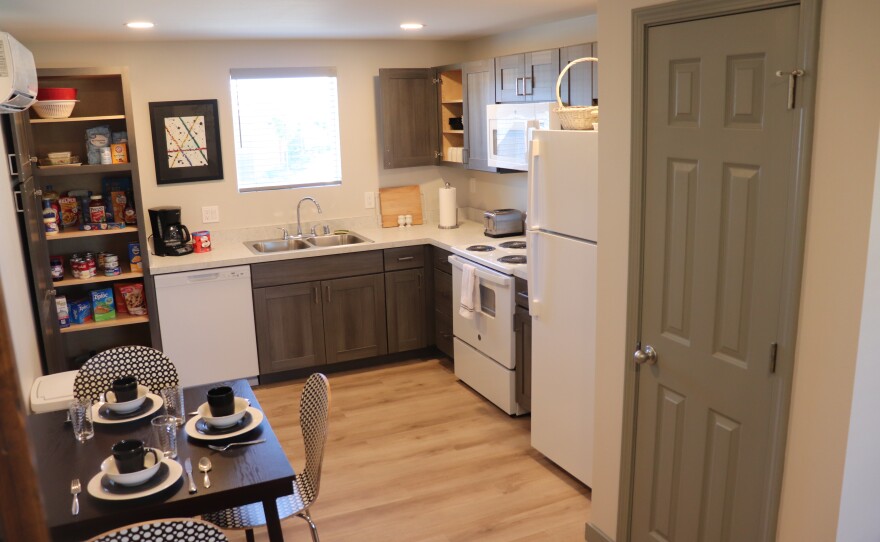
Solar panels dot the roofs of the apartments, which are built from remodelled school portables. Saranam officials said the unusual approach cut the construction cost by about half per square foot.
At the grand opening last week, Heinrich toured the facilities to see how the organization helps get — and keep — families off the street.
Saranam Executive Director Tracy Weaver led Heinrich through the newly remodeled family center, which used to be the Taylor Ranch Library in the 1980s.
As she walked Heinrich through the multi-use classroom space, she said they’ve been focused on evaluating outcomes, not just when families complete the program, but over the long term.
“We get that data every year from our alumni and our alumni survey, and we've been working with the (University of New Mexico) Evaluation Lab to really look at how are our families after they leave? Have we really changed something? And that’s that 87% stability rate.”
“That’s amazing.” Heinrich replied. “That’s a remarkable number.”
“Families that leave successfully remain stable,” Weaver said.
Saranam, which means “refuge” in Sanskrit, welcomed its first families in 2004 and has since served hundreds.
This is the nonprofit’s second campus. Its first in Albuquerque’s Northeast Heights houses 24 families. They’ve been building the new campus since 2022, and Weaver said they’re excited to help more families.
“We just moved 11 in on Tuesday here (at the west side),” Weaver said. “That's more children going to school with stability, more parents setting goals and reaching them, and more families moving toward an end to generational poverty and homelessness.”
Saranam’s goal is no small matter. Weaver said they seek to eliminate homelessness and poverty in families. As in — all — homelessness and poverty in families. The organization was originally started when a $4 million endowment was given to a small local church specifically for that purpose.
Participants can be referred to apply for the two-year long program. If selected the whole family will live in free housing, receive job and education placement assistance, partake in classes on nutrition, health, parenting, financial literacy and more for the length of the program.
Weaver said the families who have already been there for a while help to interview applicants.
“They've just done their employability class, so they have just learned how to interview, and they get to be on the other side. And it's pretty interesting to hear some of their comments like, ‘oh my goodness, did you see what that makeup that she was wearing for an interview?’ and it’s like ‘do you know what you looked like last year too?’” Weaver laughed, and continued. “In other words, they've come a long way, and they recognize the work that they've put in for the first year. They're a whole different person.”
Saranam only accepts families, though they are committed to accepting families in any form, as long as it's at least one adult with at least one minor in custody. The form of the family could be anything, Weaver said, Single parent or nuclear family, grandparents or two moms, aunts and uncles or legal guardians — all are accepted.
The program is for only families because it hinges on a two-generational approach, addressing both immediate concerns, and building long-term resiliency for the future. Weaver explains to Heinrich the program is based on three major keys, housing, education and community support.
“I always say housing is the foundation. It's Maslow's hierarchy of needs, right? If you are not safe and if you don't have your survival needs met, you're not going to be able to work on anything else. So we give them the opportunity to then do the education, do the community building, deal with whatever the trauma is, all of the different things” Weaver said. “We let them set their goals, and we help them reach their goals.”
After the private tour, about 130 people sat outside in front of the campus’ playground and community garden for the grand opening ceremony. Weaver kicked things off, pointing out the new site means Saranam can now help 54 families a year across its two campuses, more than double what they could with just their original location.
“This is not the finish line. This is the foundation. It's a foundation for continuing to serve families in Albuquerque and it's a foundation for thinking bigger about what's possible moving forward,” Weaver said. “What we have built here matters deeply, but what we do next matters even more, because the true measure of this campus will not be these buildings. It will be the lives that are changed within them, the families who move forward with stability, and the generations of children who grow up knowing that something different is possible.”
Heinrich told the crowd putting together housing and education with a supportive community creates stability.
“Those are the things that allow people to reach their potential,” Heinrich said. “We need to scale this. This is what success looks like, and this is how we should be meeting our challenges with people who don't currently have homes.”
Weaver said Saranam is already working with organizations around New Mexico, Colorado and Texas to bring the model to other cities.
Danuta, the woman who spoke with Heinrich, told the crowd Saranam has given her more than just a roof over her head. They’ve given her dignity.
“Walking through Saranam’s doors was like stepping into the sunlight after years of rain for the first time. I could exhale without fear. Can y'all do that with me?” Danuta urged the audience along. “Everybody breathe in.” The sound of more than a hundred people breathing deeply emerged from the crowd. “ And out. I can breathe now.”
She said her time there is doing more than just meeting her immediate needs for today, it’s helping her build her dream for tomorrow.
Support for this coverage comes from the W.K. Kellogg Foundation.


