It’s a mild, summer morning in the Albuquerque Bosque.
The thin ribbon of green – known to almost every New Mexican – runs straight through the city and borders one of the most essential water sources in the American Southwest: the Rio Grande.
But this season, the river is depressingly low, the ground is bone-dry, and the sunlight is warm. Signs of drought-stress are showing on some of the mighty cottonwood trees, whose leaves brown and fall to the forest floor.
Busy at work underneath the tree canopy are two people who make their living off smell who are foraging for what they call “unwanted” desert plants.
“The ‘unwanted’ part means not native here and taking up more space than it should be,” said Cebastien Rose, one of the owners of the Albuquerque-based perfumery Dryland Wilds. “Or, it means a native aromatic that’s already been cut and going to the dump or going to be burned.”
Rose and their partner, Robin Moore, upcycle these undesirables into perfumes or skincare products.
“Basically, in a less glorified way, we are perfume vultures,” Rose adds, with a wide grin.
The pair float from bush, to shrub, to tree, excitedly pointing out which can be used in a kimchi dish or as an antioxidant.
“Oh my god, I love it, love it, love it,” Rose said as they grabbed a salt cedar branch. “You need a good nose to smell it. It’s spicy. It’s sweet. It’s powdery…”
Then, just for a fleeting moment, we catch a whiff of the unmistakable and intoxicating invasive Russian Olive tree, with its notes of sweet honey, butter, and tropical fruit.
“It is the quintessential ‘Bosque’ smell, right?” asks Moore. “It has become a part of our association with this beautiful place we live in.”
Late spring/early summer evenings are the perfect time to smell this tree, as its bold flowering aromatics carry far with even the slightest breeze. Sometimes its smell changes with the time of day– morphing into a jasmine, musk or even cinnamon note.
As far as she’s aware, Moore said they are the only perfumery in the world that makes a scent from the Russian olive tree.
That’s because it involves a painstakingly traditional form of perfume making called “enfleurage,” which involves harvesting tens of thousands of the tree’s flowers.
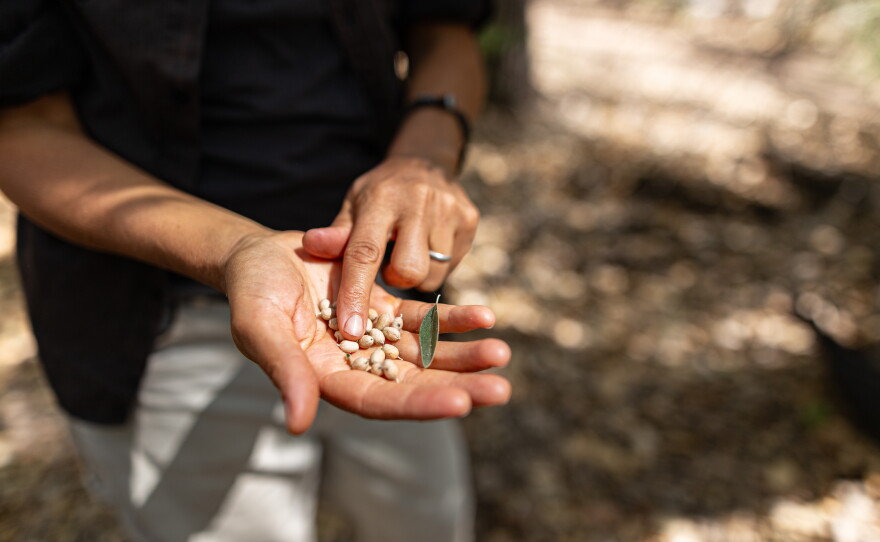
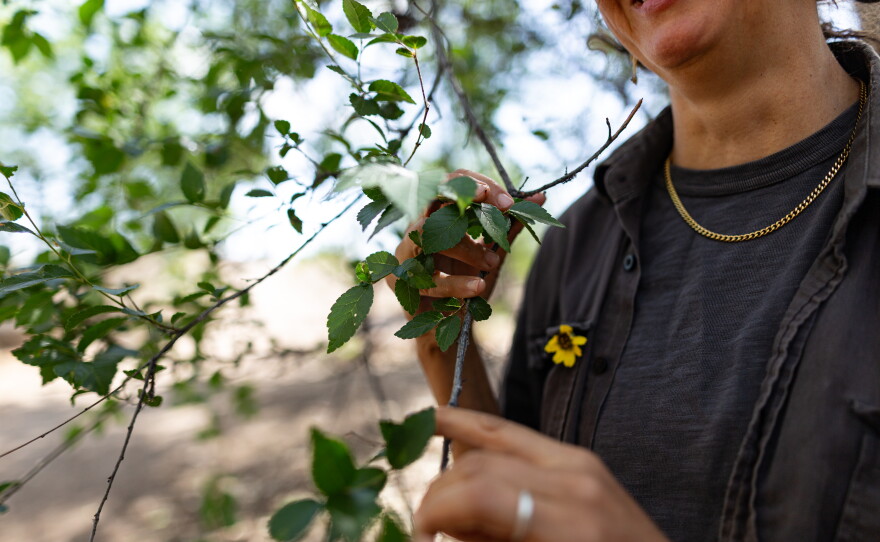
Historically, the flowers are dried and placed on a layer of animal fat, which slowly draws out their aromatic compounds. Instead, Dryland Wilds uses a mechanically defragranced coconut oil. The process takes at least 6 months from start to finish.
They’re always sold out.
But, Moore says, drought and warm temperatures are changing the flowering season. In extreme circumstances – such as this year – it came two months early, making it very difficult to find flowers ripe for their enfleurage.
That timing also threatens a whole ecosystem’s health, because pollinators – bugs, birds, and butterflies – don’t just show up early. Drought also affects how plants reproduce, providing fewer flowers, much smaller petals, and, by extension, far less nectar.
Kim Eichhorst, program director for the Bosque Ecosystem Monitoring Program, says she’s seen the forest change right before their eyes.
“Climate change is rapidly shifting things, but it's also going to force our hand because we won't be able to restore a cottonwood forest along the entire river.”
Observers like Eichhorst can tell conditions are dry because there are lots of darkling beetles, otherwise known as stinkbugs. In wetter conditions, there are typically more ground beetles.
“We're really seeing that shift first in the arthropods because you have really short life cycles,” Eichhorst said. “So, they are really sensitive to any sort of change in their ecosystem.”
Eichhorst says that, since the 1990s, the program has observed an 80% decline in cottonwood trees – and ongoing drought is going to force some tough management decisions.
“If you really want natives, you're going to have to think of a lot of our dryland species,” Eichhorst said. “It can't be what we grew up with.”
That means the water-loving riparian and native plant life that call the Bosque home – such as the Rio Grande cottonwood, Goodding’s willow, yerba mansa, and New Mexico olive to name a few – will disappear.
Although it’s no secret that a warming planet is harmful for biodiversity, it’s also harming our sense of smell. In turn, that affects our emotional and psychological well being, according to neuroscientist and expert on the psychological science of smell, Rachel Herz.
“One of the issues that affects our sense of smell is the amount of things that we can smell, and the more things that we can smell, the better our sense of smell is,” Herz said.
Turns out, those sweet, spicy, powdery, and earthy smells of hyper-local ecosystems are deeply connected through the unique function of the medial temporal lobe of the brain.
“This is where emotion and emotional memory processing takes place, and associative learning and all the critical features that make the sense of smell so unique and special,” said Herz.
In addition to the ongoing loss of biodiversity from global warming, Herz says a constant exposure to extreme heat and urban chemicals – such as sun-baked asphalt – kills off the very sensory neurons that help us smell.
That’s why people living in cities are prone to smell loss, especially when compared to rural areas.
Luckily, Herz said by removing yourself from a polluted environment and spending time around many different fragrances, a lost sense of smell can come back.
Even in the dry Bosque, the forest still has its smells that make perfumery owner Cebastien Rose absolutely swoon.
“Oh, my god, it smells so good. It's one of my favorite, favorite, favorites,” they said.
But if those smells go away, Rose said they are not worried about their business – they’re really worried about the planet and all of us on it.