The bosque along the Rio Grande snakes through the heart of Albuquerque, creating about 22 miles of uninterrupted dirt trails.
The dense and sprawling cottonwood tree canopy provides much needed respite from the unforgiving afternoon desert sun, clocking in around 5 to 7 degrees cooler than the city’s more developed areas in the summer.
Because of this, the unpaved, dirt trails lining both sides of the river are frequented by many: including runners, cyclists, equestrians, bird-watchers, or those simply trying to escape the buzz of the city.
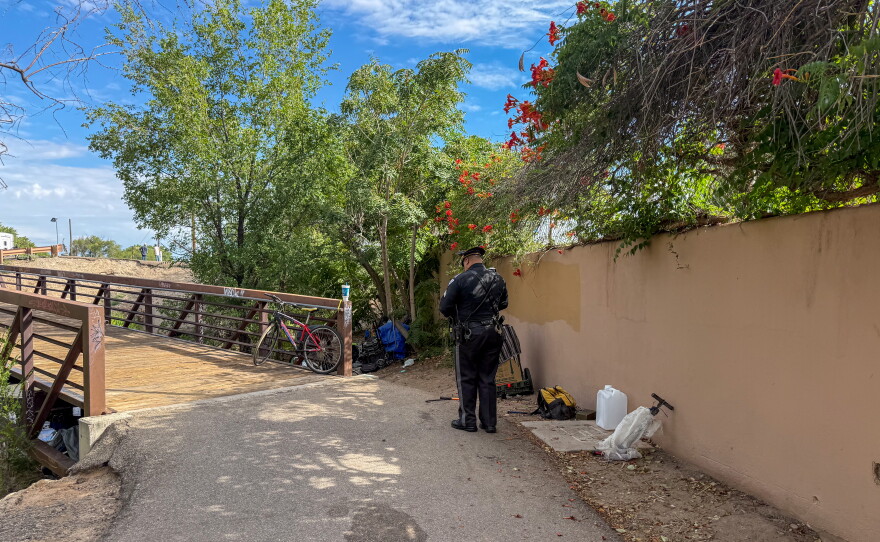
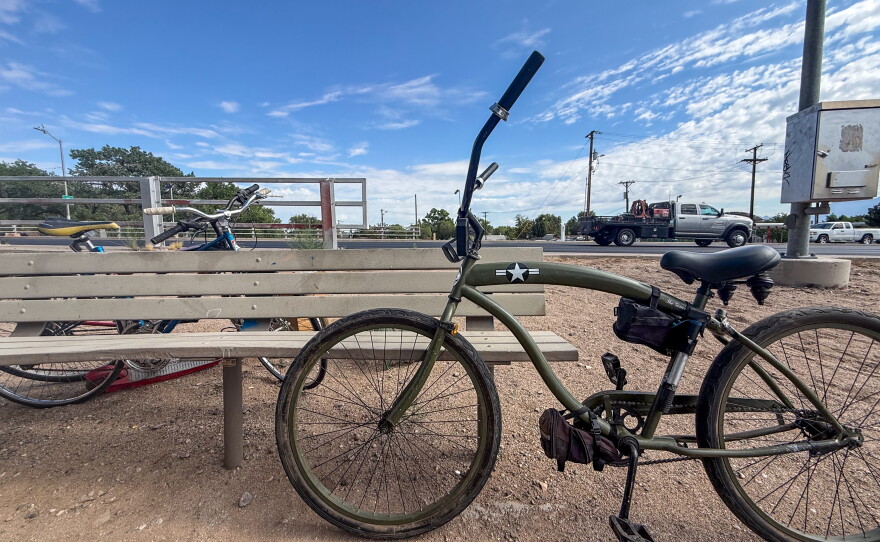
On a hot day in July, just on the edge of the Paseo del Bosque trailhead right by the National Hispanic Cultural Center in Albuquerque's historic Barelas neighborhood, several people hurriedly gathered an assortment of things – bicycles, clothes, food.
A group of State Police officers stood watch nearby.
“They are camped out here, and they have obviously tents set up underneath the bridge,” said New Mexico State Police patrolman Christian Roman, who was assisting in what he called an “operation” to deter crime in downtown Albuquerque. “They got all of their belongings all along the walls and stuff, and it's blocking off the traffic for the folks that are actually on the trails.”
He said the group of six unhoused people was trespassing on the city-owned and maintained public property.
“We were requested by the governor to come out here,” Roman said. “To make sure that in [the] downtown area everybody's safe, all the big businesses and stuff, or the museums and public areas, people feel comfortable going to without worrying about the homeless being in their way or having any issues.”
Last year, Gov. Michelle Lujan Grisham decided to focus on Albuquerque’s long-standing crime problem by declaring a state of emergency – authorizing the use of the National Guard and other law enforcement resources to patrol “high crime” areas, despite a downtick in major crimes between 2024 and 2025. They named it “Operation Zia Shield.”
In the background, a man and a woman hurriedly gathered their things – which included a 5-gallon water cooler jug, tents, and fishing poles – under the close supervision of a handful of officers.
The man, who identified himself as Pablo Moreno Olguin, said they were told to leave by the officers the day before, but struggled to find a shelter that is both safe and comfortable.
“The bad thing [is] that when you stay there overnight, it’s like being in jail,” Olguin told KUNM.
He said that it’s fairly common for the city to pester the homeless community out of public spaces for loitering or resting. In some cases, speakers blaring loud music have been set up in shared spaces.
“Sometimes they throw their stuff out, like they’re animals,” Olguin added.
State Police on scene refuted this, saying that they don’t typically throw away belongings. Although, sometimes officers are told campsites need “to go” and they assist in moving belongings out of an area.
“We don't just say: ‘Hey, you're going to jail,’ and throw their stuff out,” Officer Roman said.
While city policy dictates that Waste Management workers are supposed to collect personal items in situations like these, only possessions that can fit into a singular storage bin – which looks identical to the rubbish containers used for weekly trash pickup – will be saved for up to 90 days.
City officials say it’s here in the bosque that unhoused people are committing “criminal activity” by illegally camping by the river, sometimes resulting in spot fires that typically erupt in the drier, warmer months.
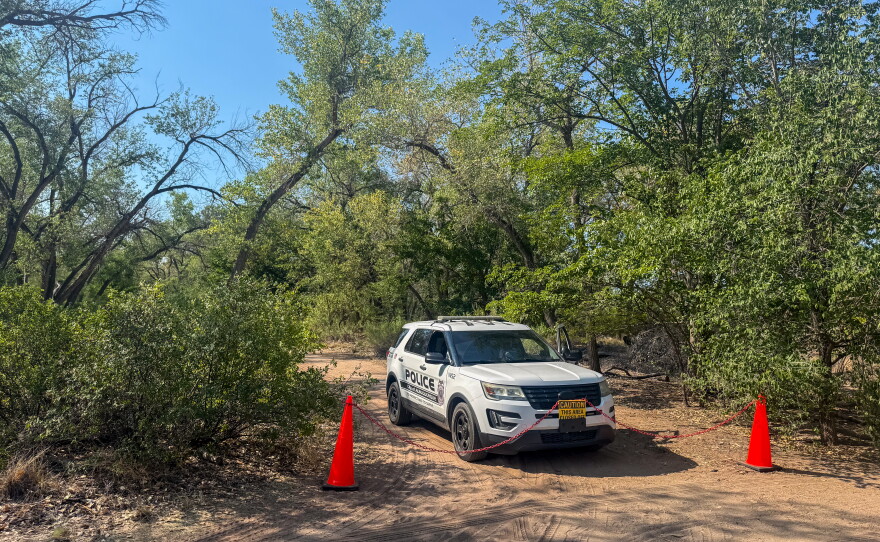
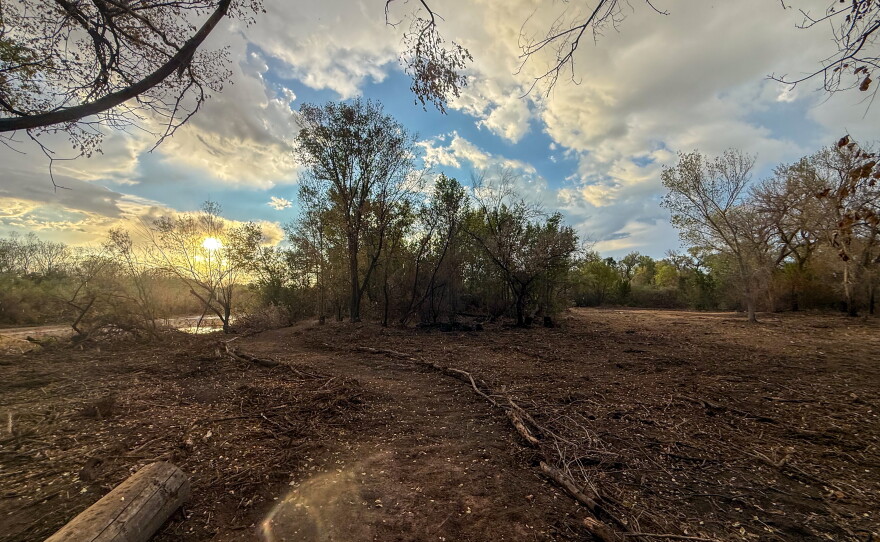
That has led to encampment clean-up crews and increased law enforcement patrols, supported by Albuquerque Police Department Real Crime Center drones equipped with high definition zoom and thermal imaging cameras to snuff out heat signatures from bodies and flames. The city says members of the National Guard are also "assisting" with operating drones and evaluating captured recordings.
When asked for an interview to respond to critiques of these policies, KUNM was referred to a year-old press release announcing APD’s drones would be used to combat wildfire and crime.
According to reporting from The Paper, footage captured by these drones is subject to standard body-worn camera policy, meaning it’s uploaded to cloud storage and held for 30 days. If tape is determined to capture any wrongdoing, such as illegal camps, it is kept longer.
Messages asking APD to verify these details went unanswered.
Crystal Danielle Zamora, one of the women who was quickly packing up the evicted encampment, said she has been on the move constantly for over a year-and-a-half.
“Every week we settle down for a couple of days – and here comes the cops,” Zamora said. “So we had to get all our stuff again and move it again out of the bosque area.”
Zamora said shelters aren’t an option for her and her boyfriend because they both suffer from post-traumatic stress disorder, making social interactions extremely difficult and stressful.
She explained that the bosque is an ideal refuge for many people experiencing homelessness, especially during times of extreme heat.
“It's a lot of shade, and we can hide most of our stuff,” Zamora said. “And cops don't really come looking for us. Only when the drones are out in the night, that's when they do the hot spots and find all the people that are out here.”
In tandem with night-time flyovers, the water-managing Middle Rio Grande Conservancy District has installed new security cameras in specific places of the bosque where they have experienced “recurring issues” of “illegal dumping, trespassing, vandalism, and human-caused fires.”
While the use of technology to monitor public spaces has been on the rise in Albuquerque, increasingly hostile city policies are now capturing the attention of advocates and the public.
Recently, this culminated into an organized sit-in on World Homeless Day when protesters gathered in Albuquerque’s Robinson Park to denounce new rules implemented by Mayor Tim Keller’s office to close the public space several times a day.
City officials say the schedule allows it to clean the park and discourage illegal behavior, sparking questions about where the unhoused are allowed to rest.
Additionally, a newly passed Albuquerque city council ordinance dubbed the “sidewalk ban” criminalizes sitting, lying, sleeping, camping or standing on a public right of way.
For urban areas, violent crimes are more likely to happen after sunset, forcing many to stay up through the night to guard their things, partners, or pets.
In contrast, the daytime presents a perfect opportunity to catch up on sleep when more eyes are about – creating a sense of safety and security.
One of the people speaking up is Rachel Biggs, executive director of Albuquerque Healthcare for the Homeless, which provides medical, dental, behavioral health, and other services for people experiencing homelessness at their campus on Mountain Road and 1st Street.
“The status quo, unfortunately, is that homelessness is increasing,” Biggs told KUNM.
Biggs said that Albuquerque is missing out on a huge opportunity to expand housing voucher programs, eviction prevention, and home construction.
Instead, she said deliberate investment in punitive technologies has helped perpetuate an endless loop of homelessness – drastically increasing health risks and discouraging behavioral change.
“When we see resources directed to enforcement activities, when we see a big focus on criminalizing people experiencing homelessness and moving people from place to place, it just makes the work harder,” Biggs said.
As it so happens, the city of Albuquerque is facing legal troubles over its increasingly aggressive treatment of the unhoused and their belongings.
“The city of Albuquerque has failed to address the root causes of homelessness, and instead is illegally implementing aggressive enforcement actions against unhoused New Mexicans that violate the state of New Mexico's constitution,” said Kristen Greer Love, deputy legal director at the ACLU of New Mexico.
The ACLU is suing under provisions of the state constitution that protect New Mexicans from cruel and unusual punishment and guarantee due process.
Greer Love argues the city is violating civil rights by forcing homeless people out of public spaces and allegedly destroying their property.
“People need to be able to exist somewhere,” said Greer Love. “Until our elected leaders respond to the housing crisis in our city, we need to make sure that the city is not punishing people simply because they exist outside on public property, with their belongings.”
In response to the ACLU’s claims, a city spokesperson emailed KUNM: “This administration has made historic investments to address the complex issues related to homelessness, including mental illness, addiction, and the need for housing.”
Advocates hope the case’s trial – which runs from Nov. 30 through Dec. 18th in the 2nd Judicial District Court – could fundamentally shift the city’s approach to homelessness.